Read More


Scaling Employee Experience Across Cities
July 21, 2026



Most companies expand their offices. Very few expand their employee experience. Here is the difference between the two and why it matters more than most expansion plans account for.
When a company opens its second or third office in India, the conversation is almost entirely about real estate. Which city? Which building? How many seats. What is the cost per square foot? These are real questions and they need answers.
What the conversation almost never includes is what the employee experience in that new location will actually feel like six months after move-in. Not the tour version. The Tuesday version. The day when nothing special is happening and the new office is just the place people come to do their work.
That gap between the real estate conversation and the experience conversation is where most multi-city expansion plans quietly underdeliver. The office opens. The headcount fills. And somewhere between month three and month six, the leadership team discovers that the experience in the new city is noticeably different from the one in the original office. Sometimes worse in ways that are hard to name. Always harder to fix than it would have been to prevent.
Why Scaling EX Is Not the Same as Scaling Offices
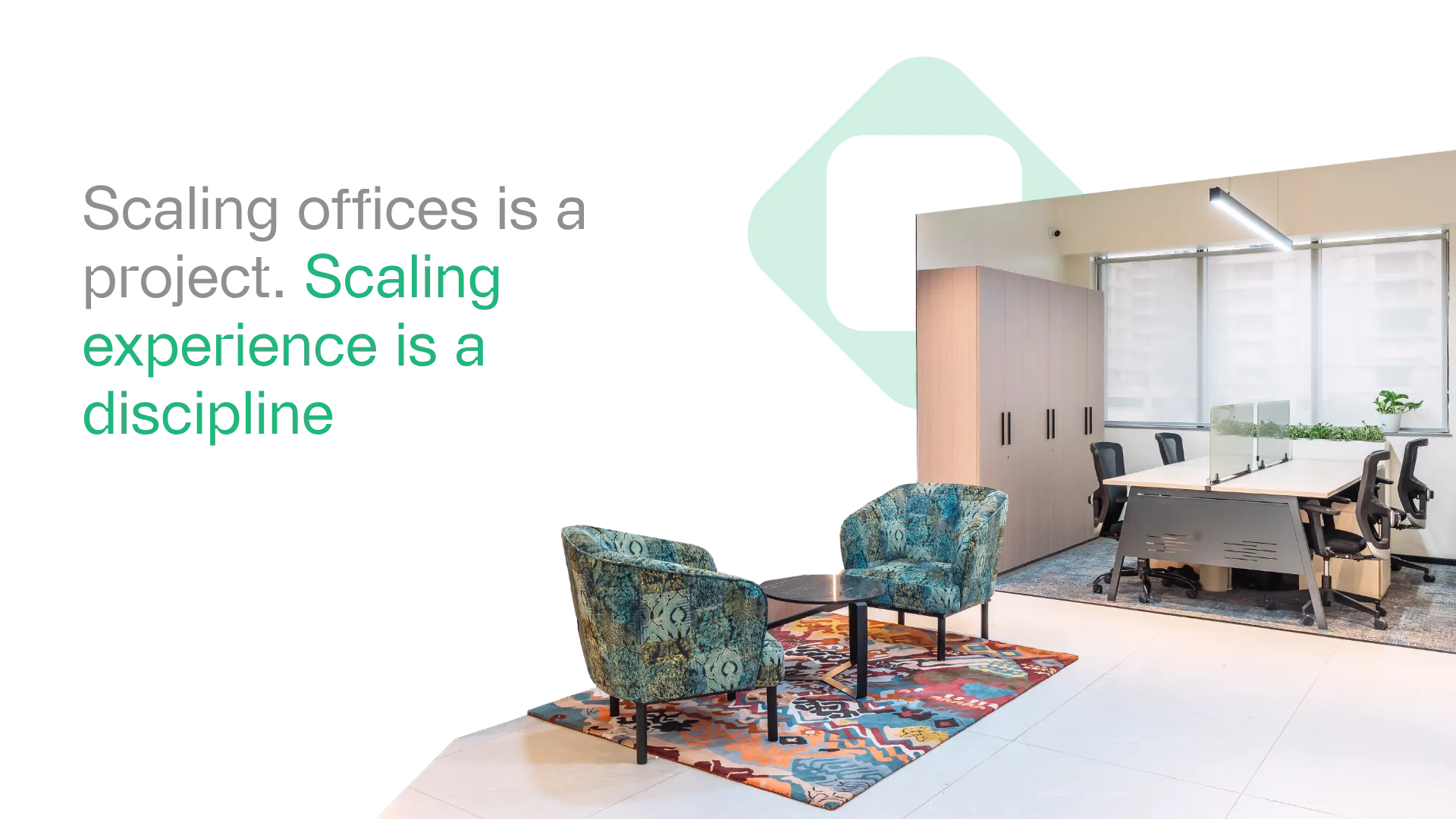
Opening a new office is a project. Scaling employee experience is an operating discipline. These are different things and confusing them is the most common mistake companies make when expanding across Indian cities.
A project has a start date, an end date, and a deliverable. The office is ready. People move in. The project closes. An operating discipline has no end date. It requires ownership, measurement, and continuous management across every location the company operates in simultaneously.
The companies that scale employee experience well have understood this distinction before they signed the second lease. They have answered three questions that most expansion plans never formally ask.
What are the non-negotiable elements of our employee experience that must be consistent across every location we operate in. What are the elements that should be calibrated to each city's specific context? And who is accountable for both.
Without answers to these three questions, the second office inherits a version of the first office's experience that degrades with distance.
What Breaks First
The elements of employee experience that break first when companies expand across cities are predictable enough that they should be planned for rather than discovered.
Operational reliability. The facilities management model that worked for one office, whether in-house or outsourced, almost never scales cleanly to two or three locations. The vendor who managed the Bengaluru office does not automatically have the same capability in Pune. The in-house admin team that handled everything in Mumbai cannot simultaneously manage Chennai. The result is a new office where the operational layer is visibly thinner than the original, and employees in the new location feel it every day in small ways that accumulate into a clear signal that the company values its original office more.
Career architecture visibility. In the original office, career paths are visible because the people who have progressed along them are present. The senior engineer who started as a junior three years ago. The manager who was an individual contributor. These visible examples of what progression looks like are part of the experience in ways that nobody formally designed. In a new city office, especially a smaller one, these examples do not exist yet. The career architecture feels abstract rather than real. And employees in the new location start asking a question that employees in the original office never had to ask explicitly. What does growth actually look like here?
Management quality consistency. The management layer in the new city is almost always less developed than the one in the original office. Either because the managers were hired locally and have not yet absorbed the company's culture, or because they were transferred from the original office and are now managing remotely with less context than they had before. Either way, the experience of being managed in the new city is often noticeably different from the experience in the original, and that difference shapes everything from daily motivation to long-term retention.
What India Specifically Makes Harder
Scaling employee experience across Indian cities is not the same as scaling it across locations in a single homogeneous market. The variables that shape experience differ significantly between cities in ways that require active calibration rather than passive replication.
The commute reality in Bengaluru is different from the commute reality in Ahmedabad. The talent expectations in Hyderabad have been shaped by a decade of GCC presence in ways that talent expectations in Coimbatore have not yet been. The infrastructure quality available to a Tier-1 city office is not automatically available to a Tier-2 city office at the same cost or on the same timeline.
The companies that scale EX well in India do not try to replicate their Bengaluru experience in Ahmedabad. They identify what the Bengaluru experience was actually trying to achieve, the feeling of being valued, the visibility of career growth, the reliability of the operational environment, and they build the conditions for those outcomes in Ahmedabad using the infrastructure and context that Ahmedabad actually has.
This is the difference between consistency and identicality. The non-negotiables are the same. The implementation is calibrated.
What the Companies Getting This Right Are Doing Differently
The companies scaling employee experience successfully across Indian cities share three operational characteristics.
They define the non-negotiables before the lease is signed. Not after move-in when the gaps are visible. Before the expansion decision is made. The non-negotiables are the elements of experience that must be present in every location regardless of city, size, or cost. Space quality above a defined minimum. Operational reliability measured by complaint resolution time. Career architecture that is visible and legible to every employee in every location. Management quality assessed and developed consistently across locations.
They build the operational layer first. The fit-out happens in parallel with the operational systems, not after them. The facilities management model for the new city is contracted and tested before employees arrive, not after the first complaint comes in. The IT infrastructure is validated for the specific requirements of the new location, not assumed to be the same as the original.
They measure experience by location, not by company average. The companies that discover their second office has a problem six months after move-in are the ones that were measuring engagement across the whole organisation. The companies that catch it at month two are the ones that measure by location, track the specific friction metrics that predict experience quality, and have a named owner for each location's experience outcomes.
CBRE's 2025 India Office Occupier Survey found that 72 percent of Indian companies expect to expand their portfolio by 10 percent or more over the next two years. That expansion is an opportunity to scale employee experience deliberately or to scale operational complexity accidentally. The companies that treat the expansion conversation and the experience conversation as the same conversation are the ones that will look back in three years and find that their second and third offices feel like the same company as their first.
The Question Worth Asking Before the Next Lease
Before the next expansion decision is made, one question is worth asking formally rather than assuming the answer.
If an employee in the new city and an employee in the original office were asked what it feels like to work here on a Wednesday afternoon when nothing special is happening, would the answers reflect the same company?
Not the same office. Not the same city. The same company. The same sense that someone thought carefully about what the experience of working here should be and built the conditions to make it real.
The companies that can answer yes to that question are the ones scaling employee experience. The ones that cannot are scaling offices. The difference is visible to every employee who works in them, even if it never appears in the expansion business case.
More Insights



Thank you for your comment! It has been successfully submitted and will appear once it has been reviewed and approved.