Read More



Operational Risks Nobody Budgets For
July 24, 2026



Every company budgets for the lease. Almost none of them budget for what happens after it is signed.

There is a version of the office decision that looks clean on paper. The lease is signed. The fit-out is complete. The move-in date is confirmed. The budget has been approved. And everyone involved feels, briefly, that the hard work is done.
It is not done. It is just becoming invisible.
The operational layer of a workplace, the systems, the vendors, the staffing, the technology, the contingencies, starts revealing itself in the months after move-in in ways that the pre-decision budget never accounted for. Not because anyone was being careless.
Because these costs are structurally difficult to see before they appear. They do not live in any line item the finance team was looking at when the lease was approved.
They live in the gap between what the office looked like during the sales process and what it looks like on a Wednesday morning six months later when three things have broken simultaneously and nobody is sure whose job it is to fix them.
This article names five of them.

The Vendor Management Gap
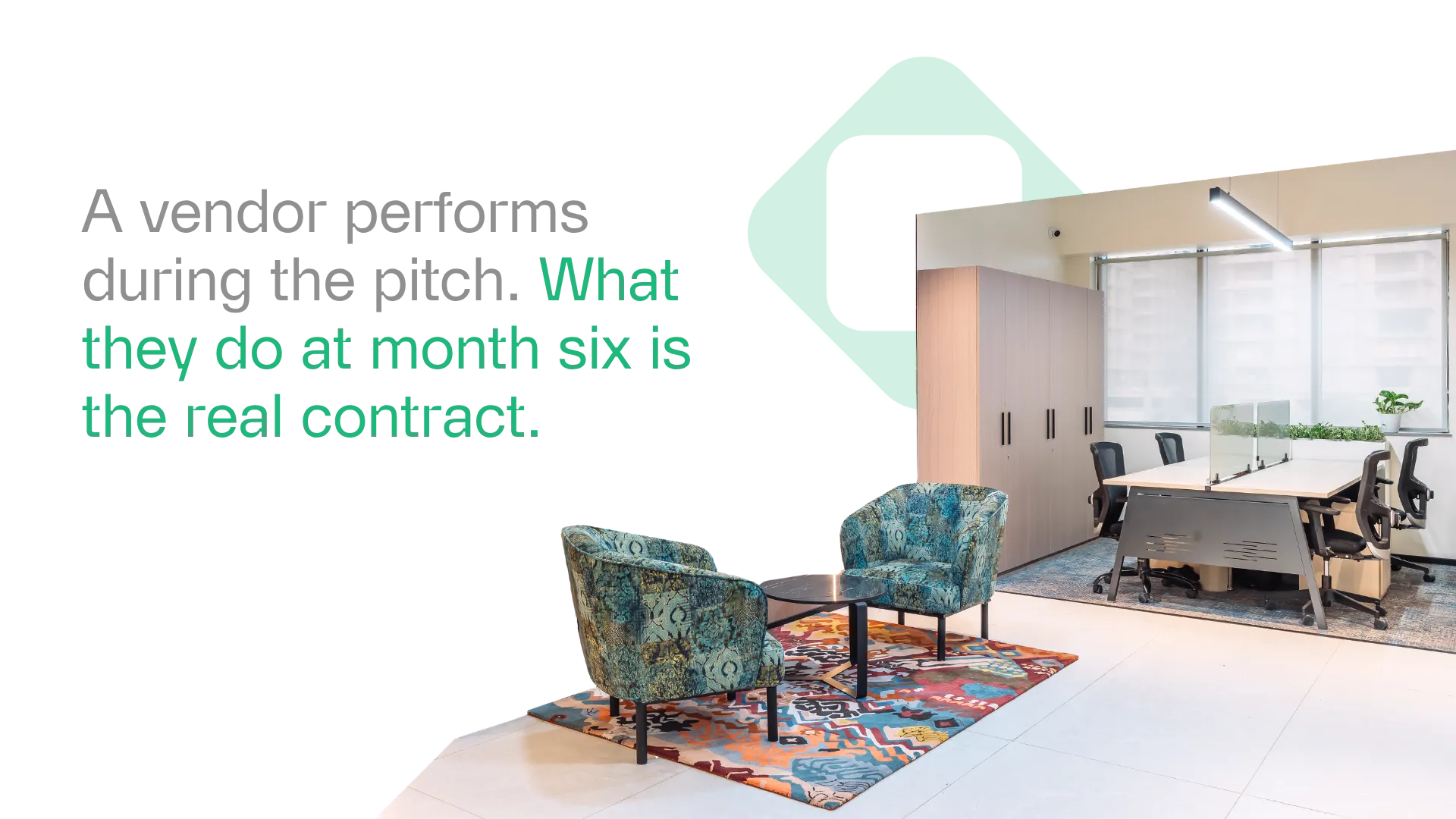
Every workplace decision involves vendors. Facilities management, cleaning, security, catering, IT support, maintenance. The vendors selected during the evaluation process are evaluated on their pitch, their references, and their pricing.
They are rarely evaluated on what their service looks like at month six when the novelty of a new client has worn off and the operational reality of their capacity becomes visible.
The vendor management gap is the difference between the service level a vendor promises and the service level they deliver consistently over time. It is one of the most predictable operational risks in workplace management and one of the most consistently underprepared for.
The gap appears in specific, recurring ways. Response times that were fast during the probationary period slow down as the relationship normalises. Issues that were escalated immediately in the first month get queued with everything else in the third. The senior contact who managed the account during the pitch hands over to a junior who is managing twelve other accounts simultaneously.
The budget implication is direct. Managing vendor performance requires time, systems, and often a dedicated person whose job includes tracking service levels, escalating failures, and managing contract compliance.
Most companies do not budget for this function because they assume the vendor relationship will manage itself. It does not.
The Facilities Staffing Gap
Ask any Admin head how many people it actually takes to run a two-hundred-person office well and the answer is almost always higher than what the company has budgeted for.
The facilities staffing gap is the mismatch between the headcount required to maintain operational reliability and the headcount that appears as a line item in the workplace budget. It is structural and predictable. Companies calculate facilities staffing based on the tasks they can enumerate during the planning stage. They do not calculate for the tasks that are invisible until something goes wrong.
The invisible tasks include vendor coordination across multiple contracts, compliance tracking for safety and maintenance obligations, proactive maintenance scheduling before failures occur, visitor management and access control, pantry and supplies management, and the category that contains everything else, which is responding to the unpredictable operational issues that arise in any occupied building on any given day.
A single admin person managing a two-hundred-person office is not understaffed in a way that looks dramatic on any org chart. They are understaffed in a way that becomes visible only when something goes wrong, they are the only person who knows how to fix it, and they are also managing three other things simultaneously.
The budget implication is the cost of the gap between adequate and actual. Either the cost of the additional headcount required to run the office reliably, or the cost of the operational failures that occur when that headcount is absent.

Technology Infrastructure Failure
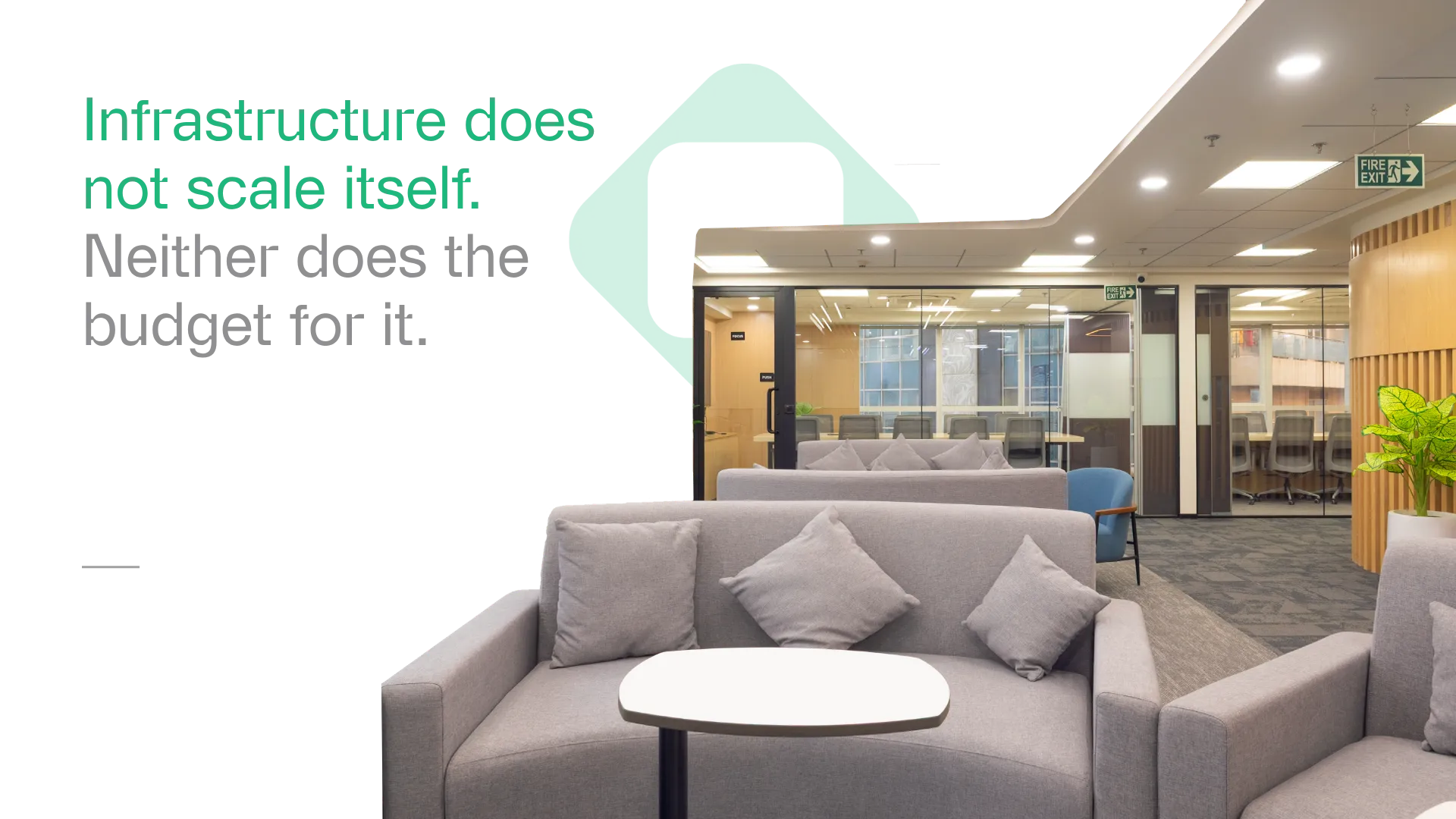
The technology infrastructure adequate for a fifty-person office is almost never adequate for a hundred and fifty-person office. This is a known pattern. It is rarely budgeted for in advance because technology infrastructure feels like a one-time decision rather than a scaling cost.
The failure modes are specific. Network capacity that was sufficient at lower occupancy becomes a constraint as headcount grows. Meeting room technology that worked when rooms were used occasionally fails when they are in continuous use. Access control systems that were adequate for one shift pattern become inadequate when the office operates across longer hours. Backup systems that were never tested reveal themselves when the primary system fails.
For global capability centres setting up in India, this risk is compounded by the specific infrastructure requirements that global HQ mandates, which are often specified for environments with different baseline infrastructure than what is available in the Indian market. The gap between what the security brief requires and what the building can deliver is a cost that appears after the lease is signed, not before.
The budget implication is the capital cost of infrastructure upgrades that were not in the original fit-out budget, plus the operational cost of the productivity loss during any period when the infrastructure is inadequate for the team using it.
Microsoft's 2025 Work Trend Index found that 80 percent of the global workforce reports lacking the time or energy to do their work. Technology infrastructure that creates friction rather than reducing it is a direct contributor to that figure. The cost is not only in the infrastructure itself. It is in every hour of reduced effectiveness it produces across every person who depends on it.
Transition Cost Between Spaces
The decision to move offices is almost always evaluated on the cost of the new space relative to the old one. The cost of the transition itself, the productivity loss, the operational disruption, the time and attention consumed by the logistics of moving a working organisation from one location to another, is almost never formally calculated before the decision is made.
The transition cost includes several components that are real but difficult to quantify in advance. The productivity loss in the weeks surrounding the move, when people are distracted by packing, uncertainty, and the disruption of changed routines. The onboarding cost for employees who do not know where anything is in the new space and take weeks to operate at full efficiency. The relationship cost of clients and partners who had to be managed through a period of operational instability. The retention cost when employees who are close to a decision to leave use the disruption of a move as the moment to act on it.
A company moving two hundred people from one location to another is not disrupting one person for a week. It is disrupting two hundred people for a period that is usually longer than anyone planned for. At any reasonable estimate of productivity cost per person per disrupted day, the number is significant enough to have changed the decision calculus if it had appeared in the original business case.
The budget implication is a transition reserve that companies almost never create because the transition cost is invisible until it is being paid.
The Missing Contingency Budget
Every workplace has things that break expensively and unexpectedly. The HVAC system that fails in summer. The fire suppression system that requires replacement during a safety audit. The flood from the floor above that damages server infrastructure. The security system that fails after a power surge and requires full replacement.
These events are unpredictable in their specifics and entirely predictable in their category. Buildings have expensive failures. Operational infrastructure fails in ways that require significant unplanned expenditure. Every company that operates a workplace long enough encounters at least one event of this kind. Almost none of them have a contingency budget that reflects the actual probability and cost of such events.
The missing contingency budget is the operational risk that companies are most consistently unprepared for because it requires budgeting for something that might not happen. The psychology of budget planning makes this difficult. Every line item that represents a possibility rather than a certainty is a target for reduction when budgets are under pressure.
The result is that when the expensive unexpected event occurs, the cost comes out of operational budgets that were not designed to absorb it, or out of a finance approval process that takes longer than the problem can wait, or out of the personal credit of an Admin head who made a judgment call and is now hoping the CFO agrees it was necessary.

What This Means Before the Next Lease Decision
None of the five risks above are inevitable. They are predictable. And predictable risks are budgetable risks if the conversation about them happens before the lease is signed rather than after.
The companies that manage workplace operational costs well share one characteristic. They treat the operational layer of a workplace as a cost category that requires the same rigour as the real estate layer. Not an afterthought. Not a line item that gets reduced when the fit-out goes over budget. A planned, resourced, and owned function with its own budget, its own staffing model, and its own performance metrics.
CBRE's 2025 India Office Occupier Survey found that 73 percent of Indian companies intend to use physical workplace design as a key focus area to enhance office experience. The design layer is getting attention. The operational layer that determines whether that design remains functional six months after move-in is getting significantly less.
The gap between a workplace that looks good on move-in day and one that still works well eighteen months later is almost always an operational gap. It is staffed, resourced, and planned for, or it is not. The companies that plan for it find that the costs are manageable. The ones that discover it after the fact find that it is more expensive than anyone expected and harder to fix than anyone wanted.
More Insights



Thank you for your comment! It has been successfully submitted and will appear once it has been reviewed and approved.