Read More


India's Office Leasing Came Within 2% of an All-Time High. Flex Space Carried It.
July 14, 2026



A commentary analysis of Knight Frank India's H1 2026 Office Market report, and what it reveals about the flexible workspace segment's growing weight in India's commercial real estate story.
4.46 Million Square Metres Leased. Almost a Record. In the Middle of Global Chaos.
Every six months, Knight Frank India publishes its Office and Residential Market report, built from its own transaction tracking across the country's eight biggest cities. The H1 2026 edition lands at an odd moment. Middle East conflict risk, US tariff whiplash, and AI anxiety about white collar jobs are all live threats to corporate confidence everywhere else in the world.
India's office market did not blink. Companies leased 4.46 million sq m (48 million sq ft) of office space in the first half of 2026, just 2% behind the record set a year earlier on an exceptionally high base. Western markets are still fighting 20%+ vacancy. India's vacancy fell to 14.6%.
That gap is the story. It is not cyclical. It is structural.
Flex Space Just Hit Its Highest Share Ever. Enterprises Are Driving It, Not Startups.
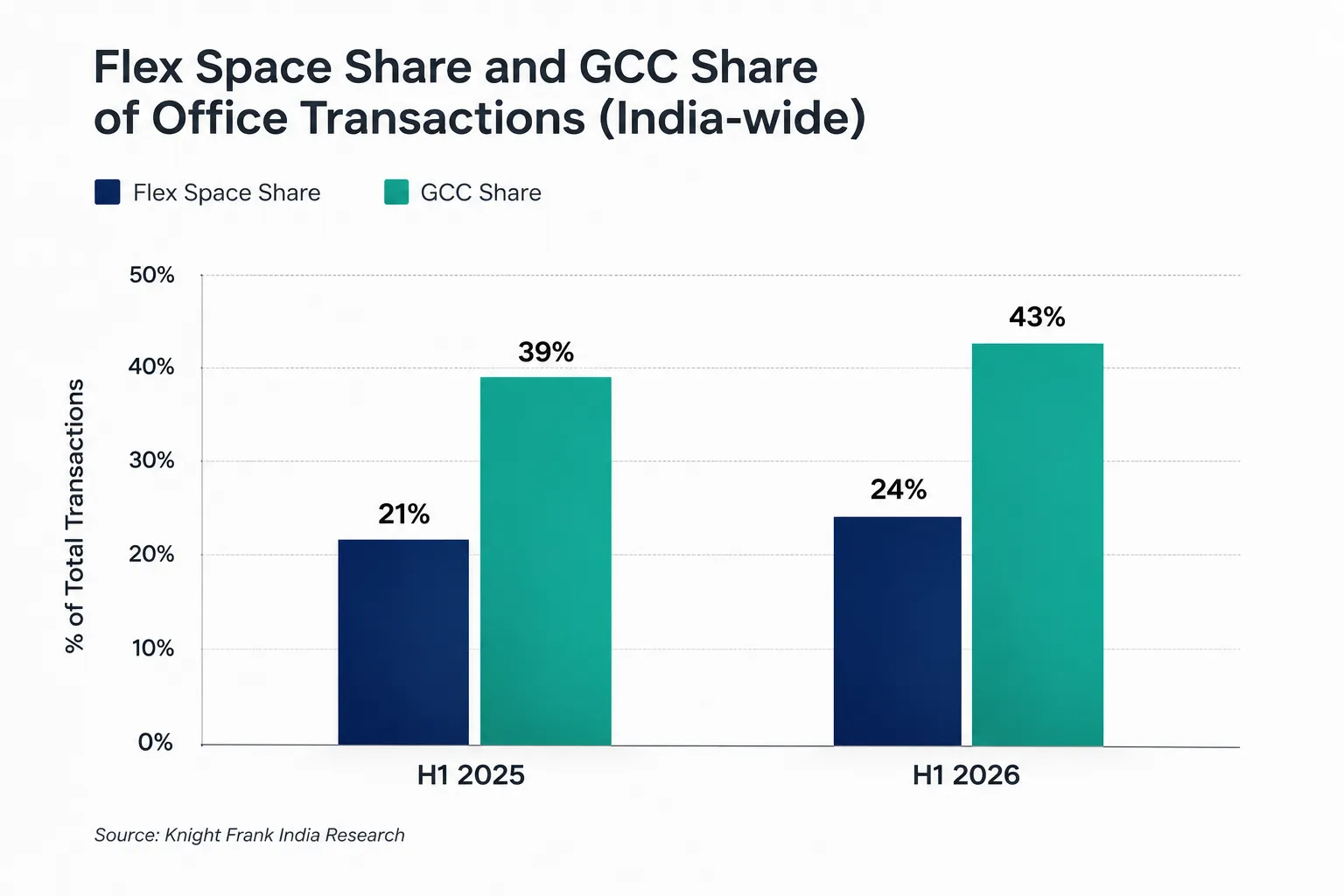
Here is the number that should matter most to anyone in a managed office or flexible workspace right now. Flex operators accounted for 24% of all office transactions across India's eight major cities in H1 2026, the highest share on record and up from 21% a year earlier.
This is not the co-working segment of five years ago. Knight Frank is explicit about who is renting flex space now:
- Large occupiers are pairing a long-term anchor lease with managed office space on the side, so headcount can flex up or down without renegotiating the whole portfolio. That matters most for GCCs and multinationals trying to plan hiring in an AI-disrupted labour market.
- The product itself has moved upmarket. Think dedicated floors with custom interiors and negotiated service terms, not a shared desk in a co-working lounge.
- For a company entering a new city, testing a small team, or opening a satellite office, flex space is now the default first move rather than a stopgap before a "real" lease.
Flex space stopped being a startup product. It became a portfolio strategy tool for the largest occupiers in the country.
GCCs Now Take Almost Half of Every New Office Lease Signed in India
Global Capability Centres leased 1.91 million sq m (20.6 million sq ft) in H1 2026. That is 43% of all office transactions nationally, the highest half year share on record for the segment, and up from 39% a year ago.
The GCC story has changed shape too. These are no longer back office cost centres. Knight Frank describes them as strategic hubs now running AI research, product development, and enterprise risk management for global parents. That shift matters for anyone leasing to them, because it means longer commitments, higher build spec demands, and more appetite for flexible expansion options sitting alongside the core lease.
Bengaluru still captures the largest share of GCC activity at 41%, but Mumbai and Hyderabad are each pulling 16%, and Pune's GCC share climbed to 32% from 25% a year ago. The GCC map is widening, not consolidating into one city.
Ahmedabad's Flex Market Just Grew 212% in a Year. DevX Was Part of That Story.
This is the number that hits closest to home. Ahmedabad's office market saw flexible workspace operators corner 45% of total transacted area in H1 2026, a 212% jump year on year. Knight Frank names the operators driving it: Opulence Spaces, Vibrant Co.Work, Incuspaze. And DevX.
The report specifically calls out DevX achieving full occupancy on its newly delivered 400,000 sq ft property on Bopal-Ambli Road during H1 2026. That is not a small data point. It means one of Ahmedabad's largest flex deliveries of the year filled up inside the same half year window that saw flex demand more than triple citywide.
Ahmedabad's office fundamentals back this up. Vacancy compressed 83 basis points to 37.1%. Rents rose 3% year on year. Total stock grew 8%. And two structural tailwinds are still ahead: the Gujarat GCC Policy 2025-30 targeting 250 new Global Capability Centres, and the 20 year tax holiday extension for GIFT City IFSC units under Union Budget 2025-26. Neither of those tailwinds has fully played out yet.
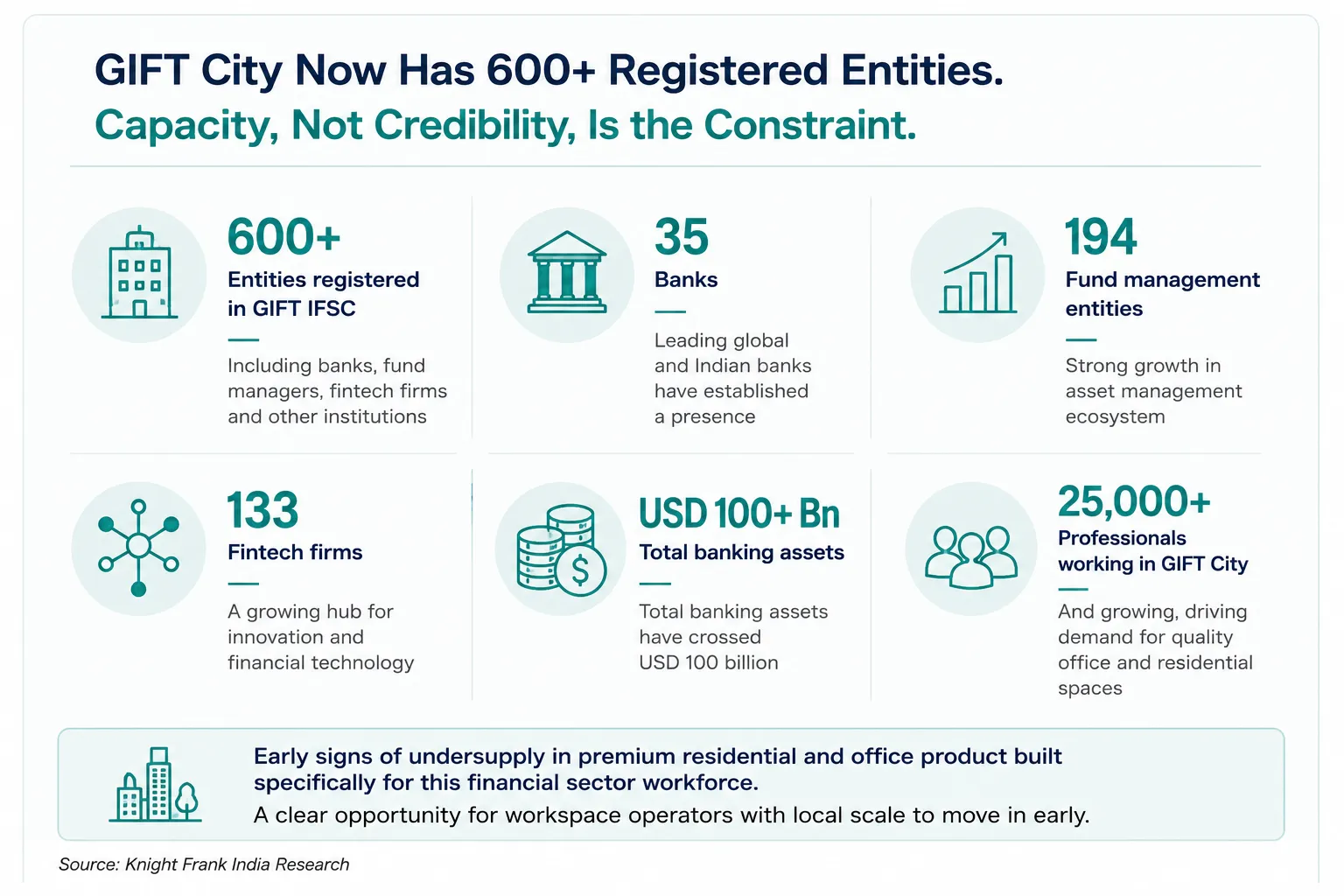
Knight Frank makes a sharp point about GIFT City that is worth repeating: the challenge there is no longer proving the concept works, it is running out of room. Over 600 entities are now registered in the IFSC, including 35 banks, 194 fund management entities, and 133 fintech firms. Total banking assets have crossed USD 100 billion. Names like JP Morgan, Standard Chartered, HSBC, Deutsche Bank, and Citi are already occupiers.
More than 25,000 professionals now work inside GIFT City, and that workforce is already showing up in residential demand in Zundal, Randesan, and Koba. The report flags early signs of undersupply in premium residential and office product built specifically for this financial sector workforce, which is exactly the kind of gap a workspace operator with local scale can move into ahead of competitors.
The Bigger Picture
Two things are true about India's office market in H1 2026 that were not true two years ago. First, leasing volumes are holding near record highs while the rest of the world's office markets sit near record vacancy, and that gap is being driven by structural demand from GCCs and enterprise flex adoption, not a temporary post pandemic bounce. Second, flex space has quietly become boardroom infrastructure. It is how the largest, most risk averse occupiers in the country are choosing to manage uncertainty, not a fallback for companies too small for a conventional lease.
For a market like Ahmedabad, where GIFT City is still filling out and the Gujarat GCC policy has not yet delivered its full pipeline, that combination points one direction: more enterprise demand for exactly the kind of flexible, high spec space that just posted a 212% growth year in this city.
We'll keep tracking Knight Frank's research alongside other major industry sources to build an ongoing, evidence backed picture of where India's commercial real estate market is headed next.
This commentary references Knight Frank India's "India Real Estate: Office and Residential Market, January-June 2026." Readers seeking the full report and methodology should consult the original publication.
More Insights



.png)

%20(1).webp)
Thank you for your comment! It has been successfully submitted and will appear once it has been reviewed and approved.