Read More


India’s Commercial Real Estate Supply Is Outpacing Demand in 2026
October 26, 2026




A commentary analysis of CRISIL Intelligence's 2026 real estate sector outlook, and what its demand-supply numbers actually reveal about the office market's next phase.
Supply Is Set to Outgrow Demand This Year
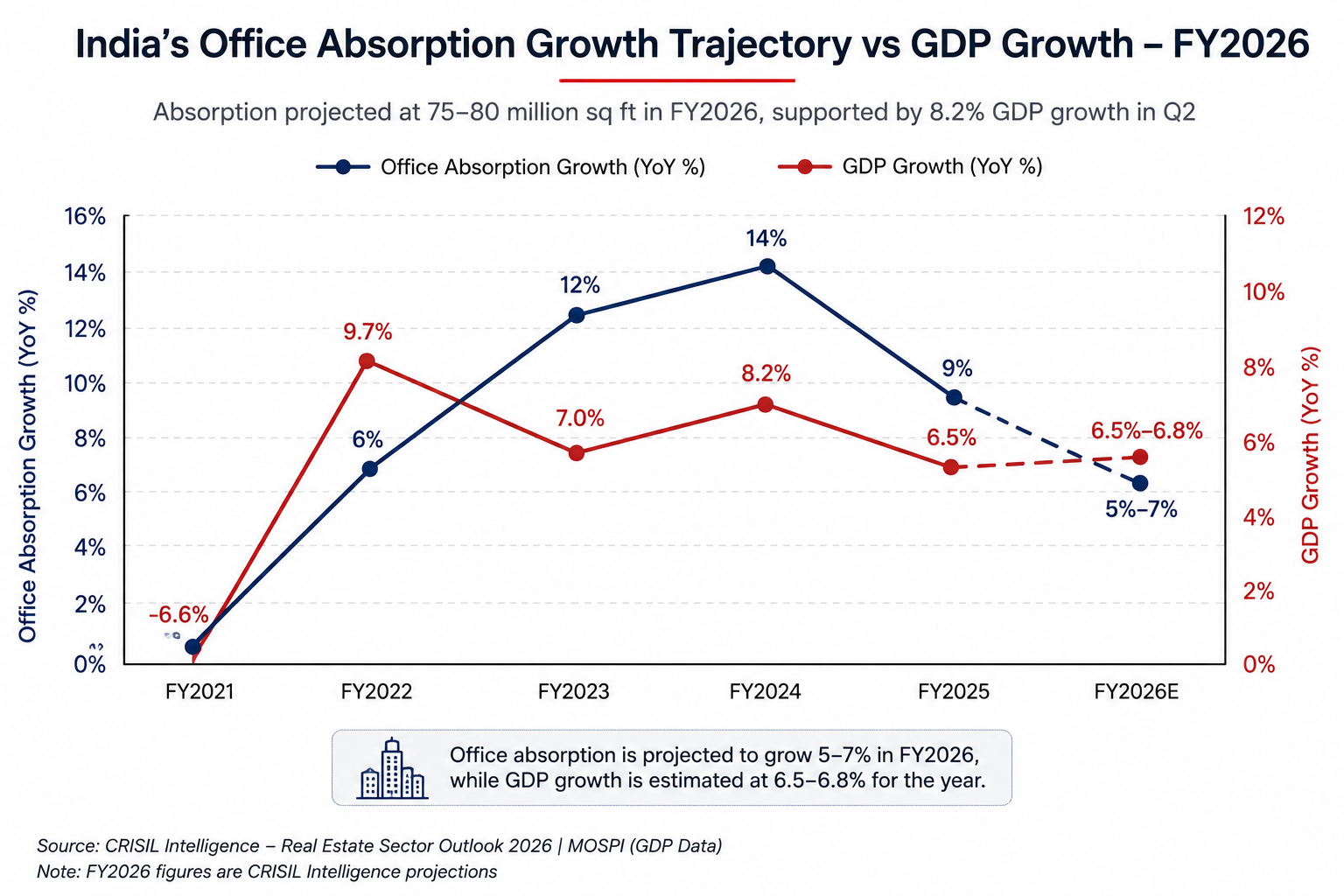
CRISIL Intelligence opened 2026 with a number that looks like a red flag until you read the fine print. Office demand is projected to grow 5-7% this fiscal year, while supply is projected to grow faster, at 9-11%. On paper, that's the setup for rising vacancy and softening rents.
CRISIL's own director, Aniket Dani, attributes the supply growth to the same forces driving the demand growth: continued leasing from Global Capability Centres, flexible workspace operators, and the IT/ITeS and BFSI sectors. In other words, developers aren't building ahead of a market they're guessing will show up. They're building to catch up with a market that's already here.
That distinction matters. Supply outpacing demand is only a warning sign when the supply isn't backed by anything. Here, it's a lagging response to two years of demand that outran what was already built.
75 to 80 Million Square Feet of Absorption Expected
CRISIL frames the office market's momentum against a broader economic backdrop: 8.2% GDP growth recorded in Q2 of the fiscal year, holding up despite global uncertainty and shifting trade dynamics. Office absorption for 2026 is projected at 75-80 million sq ft, a number CRISIL ties directly to Global Capability Centre expansion and flexible workspace growth rather than to any single sector.
That framing lines up with what other firms have been reporting for the same period. JLL clocked 21.5 million sq ft leased in Q1 2026 alone, on pace with an absorption run rate CRISIL's full-year projection would support. When a research-and-ratings firm's macro forecast and a real-estate broker's quarterly transaction count point the same direction, that's a stronger signal than either number on its own.
The Real Story Might Be What Happens After Metros Fill Up
Industry voices speaking alongside CRISIL at the same outlook briefing flagged something worth tracking closely: Tier-II and Tier-III cities are expected to take on a larger share of India's real estate growth in 2026, driven by improving connectivity, rising local employment, and new industrial corridors.
That's not a CRISIL number specifically, it came from NAREDCO Maharashtra's leadership commenting at the same event, but it's consistent with what CRISIL's own supply-demand framing implies. If office demand and supply are both growing fastest in cities that are already tight, like Bengaluru and Hyderabad, the next leg of growth has to come from somewhere. Tier-II markets with improving infrastructure are the logical release valve.
Stressed Assets Are Recovering Faster Too
A separate CRISIL analysis adds a useful data point on the financial health side of the sector: debt recovery in stressed real estate projects is expected to improve from 22% in FY25 to 38% in FY26, helped by strategic debt restructuring through Asset Reconstruction Companies. Real estate also remains India's second largest employment generator after agriculture, accounting for roughly 18% of national employment.
That recovery rate matters beyond the balance sheets of a handful of distressed developers. A sector where stressed assets are getting resolved faster is a sector where capital, including institutional and lending capital, has more confidence returning to fund new supply. That's the other side of the 9-11% supply growth number: it needs financing to happen, and financing conditions are improving in parallel.
The Bigger Picture
CRISIL's 2026 outlook reads less like a forecast of new demand appearing and more like a description of existing demand finally being caught up with. GCCs, flex operators, IT/ITeS, and BFSI are the same names showing up across every report we've covered so far this year, from Knight Frank to JLL. What CRISIL adds is the supply-side and financial-health context: developers are responding to real, already-proven demand, and the capital structure underneath the sector is healing faster than it has in years.
The open question for 2026 is whether Tier-II cities can absorb enough of the next wave that metros like Bengaluru and Hyderabad don't simply tighten further. We don't have a dedicated ICRA report to weigh in on that alongside CRISIL yet. If you have a specific ICRA outlook or PDF you'd like included, send it over and we'll fold it into a fuller comparison.
We'll keep tracking CRISIL's research alongside other major industry sources to build an ongoing, evidence backed picture of where India's commercial real estate market is headed next.
This commentary references CRISIL Intelligence's 2026 real estate sector outlook commentary, as reported at industry briefings in January 2026, alongside CRISIL's separate analysis of stressed asset recovery rates.
More Insights



Thank you for your comment! It has been successfully submitted and will appear once it has been reviewed and approved.